


Institutional Strategies for Integrity
Introduction: Strategies for Integrity
It is widely recognised that supporting academic integrity requires a multi-faceted, whole-of-institution approach (e.g. Bretag & Mahmud, 2016; Brickhill et al., 2025; Eaton, 2023). By drawing on the expertise and support of multiple stakeholders, higher education institutions can foster a culture which champions a positive and proactive approach to academic integrity. The International Centre for Academic Integrity (ICAI) interprets academic integrity as a commitment, even in the face of adversity, to six fundamental values: honesty, trust, fairness, respect, responsibility and courage (ICAI 2021, p. 4). ICAI suggest that from these values 'flow principles of behaviour that enable academic communities to translate ideals into action' (ICAI, n.d.).
The Swiss Cheese Model

Note: From "Why students choose not to cheat" by K. Rundle, G. Curtis and J. Clare, 2020, in T. Bretag (ED), A Research Agenda for Academic Integrity, p.102, Edward Elgar Publishing. Copyright 2020 by Tracey Bretag.
There is no single way to prevent breaches of academic integrity, and no one approach or strategy is guaranteed to prevent misconduct. Rather, it has been suggested that a 'Swiss Cheese' amalgamation of strategies should be adopted (Rundle et al., 2020). Drawing on the 'Swiss Cheese' approach to accident or infection prevention, Rundle et al. (2020) propose a multi-method model to address the causes of, and barriers which prevent, plagiarism and cheating in higher education: they argue that there is no 'completely faultless device for stopping students engaging in cheating' (2020: 102), rather, 'higher education institutions and teaches put in place multiple, but imperfect, barriers to prevent cheating' (2020: 103). Similar to layering slices of Swiss cheese with the aim of misaligning holes, we must seek to create barriers, that though imperfect, seek to limit the number of students who can slip through the holes in our layers of prevention and detection. This approach is captured in the diagram above.
MIC aligns with other institutions by proposing an adaption of this model to promote a cross-institutional view of supporting academic integrity, organised around four supporting pillars as follows:
- Environment
- Strategies for teachers
- Strategies for students
- Policy
Applying the Swiss Cheese Model
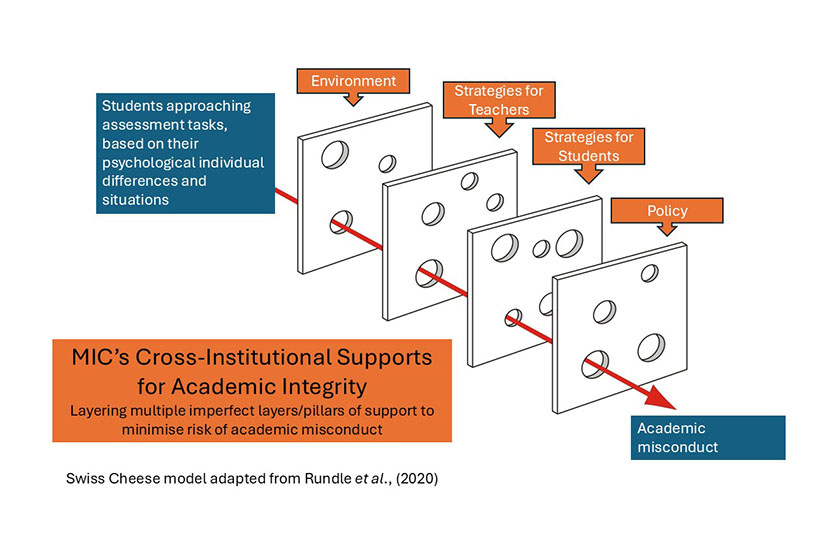
This multilayered and holistic view recognises that academic integrity is best supported through multiple, supporting and overlapping areas of activity. The model depicted above adapts Rundle et al's (2020) conceptualisation to make it more appropriate for the MIC context. It proposes a multi-stakeholder view of academic integrity, which recognises that the promotion of academic integrity involves all members of the College community, encompassing teaching, learning and assessment activities and the broader policy environment. The pillars (or layers) depicted below are not viewed as static but rather reflect the ever-evolving ambition to foster and promote positive academic integrity behaviours. The model offers a framework for a whole-of-institution-level consideration of what barriers and enablers can be put in place to strengthen academic integrity, while recognising that there is no singular way to prevent breaches of academic integrity. The pages in this section of the microsite offer an overview of how each of the four pillars (Environment, Strategies for Teachers, Strategies for Students and Policy and Guidelines) can be used to support a holistic view of academic integrity, aiming to reduce the risks of academic integrity breaches for students.
Bretag, T. & Mahmud, S. (2016). A conceptual framework for implementing exemplary academic integrity policy in Australian higher education. In Bretag, T. (ed) Handbook of Academic Integrity, Springer, Singapore: 463-480.
Brickhill, M., Andrews, G. & Nieuwoudt, J. (2025). Developing Student Agency Towards Academic Integrity Through an Educative Approach: exploring students’ experiences and perspectives. Journal of Academic Ethics, 23: 951–975.
Eaton, S.E. (2023). A Comprehensive Academic Integrity (CAI) Framework: An Overview. Calgary, Canada: University of Calgary.
International Centre for Academic Integrity [ICAI] (2021). The Fundamental Values of Academic Integrity. (3rd ed.) Accessed 29 September 2025.
International Centre for Academic Integrity [ICAI] (n.d.) 'Welcome to ICAI!', International Center for Academic Integrity. Accessed 29 September 2025.
Rundle, K., Curtis, G. and Clare, J. (2020). 'Why students choose not to cheat'. In Bretag, T. (ed). A Research Agenda for Academic Integrity'. Cheltenham: Edward Elgar Publishing: 100-111.

Except where otherwise noted, content on the LEAD section of this website is licensed under a Creative Commons Attribution 4.0 International licence.
Institutional Strategies for Environment
Creating an environment that fosters academic integrity
Academic integrity is a shared responsibility that underpins the values of higher education. Whether we are staff or students, each of us plays a vital role in fostering a culture of honesty, fairness, and respect. Acting ethically means supporting one another in making responsible choices, through open dialogue, transparency, and accountability. By committing to integrity in our teaching, learning, research and studies, we help create an environment where trust can thrive and where academic achievements truly reflect effort and understanding.
MIC's Commitment
MIC is committed to fostering a learning environment which is grounded in the principles of academic integrity, as identified by the ICAI: these are honesty, trust, fairness, respect, responsibility and courage. As such, MIC aims to adopt a holistic view of academic integrity which sees it as underpinning all facets of teaching and learning. This aligns with the 'Comprehensive Academic Integrity (CAI) Framework, as proposed by Eaton (2023), which posits that 'academic integrity must encompass, but extend beyond, notions of student conduct, and should be considered a foundation of all aspects of education' (2023, p. 2). The CAI framework includes eight essential elements and extends beyond traditional notions of academic integrity merely as student responsibility. Rather it should be composed of the following:
- Everyday ethics
- Institutional ethics
- Ethical leadership
- Professional and collegial ethics
- Instructional ethics
- Student academic conduct
- Research integrity and ethics
- Publication ethics

Eaton's framework can be used by all members of the MIC College community to consider their role for promoting and upholding the values of academic integrity. It recognizes the multi-institutional nature of academic integrity, and the focus that we all commonly share on creating an environment which places academic integrity at the heart of all our activities.
Creating MIC's Learning Environment
MIC creates a learning environment which promotes academic integrity through the following ways:
- A comprehensive Academic Integrity Policy.
- Supports for staff and students that are in place to help us all uphold the values of academic integrity (through for example the work of Academic Learning Centre, LEAD, MIC Library and the Research & Graduate School).
- A robust programme approvals and quality assurance process which considers how curriculum and assessment design can support academic integrity.
- Ongoing professional development for staff to enhance their teaching and learning approaches to promote academic integrity.
For further guidance in relation to how staff and students can support academic integrity, please see the Strategies for Teachers and Strategies for Students sections of this website.
References
Eaton, S.E. (2023). A Comprehensive Academic Integrity (CAI) Framework: An Overview. Calgary, Canada: University of Calgary.
Except where otherwise noted, content on the LEAD section of this website is licensed under a Creative Commons Attribution 4.0 International licence.
Strategies for Students
On this page, students will find some advice on steps that you can take to support your own academic integrity. It includes guidance from staff in the Counselling Service and Academic Learning Centre, who are committed to ensuring that MIC students approach their learning in a way that best upholds the values of academic integrity. Please take some time to review the sections below, and feel free to contact any of the services mentioned for further guidance.
At the end of the page, you will find a list of links to relevant websites and guides. You are warmly encouraged to use this information throughout your time in MIC to assist you with referencing and citing sources as you prepare your academic assignments.
Advice from Dr Paula Seth, Head of Counselling at MIC.
Caring for your mental wellbeing is essential for success as a student at MIC and is also closely linked to academic integrity. Academic pressures, tight deadlines, and personal responsibilities can sometimes feel overwhelming. In stressful moments, reliance on generative AI may seem like a quick fix, sometimes without fully considering the implications. When panic sets in, it becomes easier to unintentionally plagiarise or misuse AI-generated material, actions that carry serious consequences.
By prioritising your mental health, you equip yourself to manage stress, build resilience, and make thoughtful choices aligned with the values of honesty and responsibility. Seeking support and developing strong study habits can help reduce the temptation to take shortcuts, which often lead to later anxiety, guilt, or fear of discovery. At MIC, confidential support services are available, offering a safe space for students to discuss any challenges impacting their studies.
Click here to access MIC Student Supports
While many students now turn to generative AI for advice during difficult periods, these tools are not designed to address complex emotional or mental health concerns. Their guidance may be incomplete or even misleading, particularly if you’re facing more serious difficulties. Relying solely on technology can deepen feelings of isolation, making it even more important to reach out to friends, family, or mental health professionals for genuine support.
Remember, MIC provides free, confidential counselling with experienced staff who are here to help you manage stress, cope with overwhelm, and address challenging situations.
Click here to access information relating to MIC Counselling Service
If you need support outside regular hours or would prefer to connect online, all MIC students can register with TalkCampus - a free, evidence-based mental health resource offering guidance and confidential peer-to-peer support forums. Simply sign in with your MIC email for 24/7 access to help and resources.
Note Taking
Poor notetaking practices can inadvertently lead to academic integrity breaches. You may lose track of your sources or fail to appropriately cite and paraphrase material that you have come across in your reading. When consulting academic sources, it is critically important that you develop a clear and consistent system for identifying the source of your material, so that you can cite them in your academic work. Failure to do so can lead to a breach of academic integrity. Furthermore, losing track of the ideas that you have read, and their sources, may unintentionally lead to you presenting someone else's work or ideas as your own.
Please see advice below from Dr James Binchy, Academic Learning Centre in relation to notetaking strategies.
Aim to develop a consistent system when reading. Note the following details while reading academic sources:
- Author
- Editor(s) (if it's an edited book)
- Chapter author (if it’s an edited book), chapter title, and page numbers
- Year of publication
- Title of book/article
- Publisher
- Place of publication
- For journal articles:
a. Author
b. Article title
c. Journal title
d. Volume/issue number
e. Page numbers
Always record source details when you first read – this saves time later. As you write your assignment, have the relevant referencing guide to hand. Vary between author-prominent (i.e., where the author's last name is included in the sentence outside of parentheses and the date of publication appears directly after the author's name in parentheses) and information-prominent referencing (i.e., where the author's last name and the date of publication is included in parentheses at the end of the sentence) for better flow. If there’s no reference, the reader will assume it’s your idea.
University lectures can be quite formal and they are held in large groups. The lecturer speaks for at least 45 minutes, and the student takes notes. Notetaking at lectures is an important skill to acquire. You will need your notes when writing assignments and when revising for exams.
It impossible to note down everything that is said in 45 minutes – the goal is to have notes that remind you of the main points of the lecture later in the semester.
Note: Recording of lectures is not permitted without prior permission from the lecturer.
How to make note taking easier for your classes
Develop the habit of performing certain tasks before, during and after lectures.
1. Before the Lecture Begins
- Read through previous lecture notes – new information tends to be based on what you have covered in past lectures.
- Be in the lecture theatre early with pen, paper, folders, highlighters or any other equipment you may need.
- Get a good seat with a clear view of the projector screen or blackboard.
- Always begin new lecture notes on separate pages – this is vital for filing later
2. During the Lecture
Write the date, lecturer’s name and module title/code at the top of the page. Pay attention to lecture structure. Most lecturers organise their lectures into an introduction, main body and conclusion.
Introduction:
This usually provides an outline of the current lecture. It sometimes includes a summary of what was covered in previous classes and shows the new topic fits with previous lectures.
Main body
The main body of the lecture outlines the main points of the topic. Be selective about what you write during the main body of the lecture, but make sure you note key names, dates, and ideas. If you have access to lecture slides, don’t waste time copying from the screen. Instead, try to understand the meaning of the lecture. Try to think as you listen: this will help you question and understand. Record any thoughts or questions that come to mind
Conclusion
This usually entails a review of the main points and this is where the lecturer will summarise the most important ideas. It can be useful to check your notes at this point and make sure they are in line with the overall message.
3. After the Lecture
To get the most from your lectures you will need to do some follow-up work. Additional reading is nearly always expected. Many lecturers will recommend texts.
Additional advice:
- Review notes after every lecture. Try to see connections between this lecture and previous ones. Look for concepts that receive regular emphasis.
- Write a summary of your notes. Condense the main points into a short paragraph at the end of your notes. Try to do this immediately after the lecture or at the end of the day – it will help you understand and remember the content.
- Go the Library and engage with the readings on Moodle. Find any key references cited by lecturers.
- Develop a filing system for your notes/handouts, either in hard copy or electronically.
Additional useful tips:
- Establish a comfortable note-taking style. These are your own notes. What is important is that you can make sense of them.
- It can be helpful to use symbols and abbreviations. Develop your own shorthand system e.g. T= theory, Dev = development, Ed = education, confirmn = confirmation. Notes should be brief. You do not need to write full sentences.
- It is a good idea to leave lines free in between points because lecturers sometimes add to earlier points.
- Be organised and develop a consistent pattern to help you make sense of your notes. Consider using numbers, roman numerals, capital/lower case letters, bullet points, different colour pens/fonts etc. Using diagrams or drawings can help you retain information.
- Remember it is difficult to concentrate fully for 45 minutes – refocus your concentration regularly by questioning yourself silently e.g. what is the main point here? How does this information relate to what I already know?
- Do not give up at any stage of the lecture. Even at the conclusion, the lecturer may refer back in a way that can help to fill in a blank!
- If you lose concentration…
- Do not panic!
- Listen for keywords to put you back on track.
- Try not to glance at your neighbours’ notes or ask them questions. This may only be a distraction.
- Leave blanks – you can follow up after the lecture.
If you would like to discuss your note-taking, call to the Academic Learning Centre and chat to one of our staff or email ALC@mic.ul.ie to make an appointment.
Referencing
When preparing assessments, you’ll often be expected to use ideas from readings recommended by your lecturer. Referencing acknowledges where these ideas came from, demonstrates your knowledge of your readings and helps you avoid plagiarism.
When preparing assessments, you’ll often be expected to use ideas from readings recommended by your lecturer. Referencing acknowledges where these ideas came from, demonstrates your knowledge of your readings and helps you avoid plagiarism.
Always use the system required by your Department/Lecturer. In MIC, the default system is Cite it Right. The Theology and Religious Studies Department use a footnoting system. This will be shared with you by your lecturer.
There are many referencing systems. The most common are in MIC are:
- Cite it Right (a Harvard style system)
- Irish Historical Studies (a footnoting system)
- American Psychological Association (a Harvard-style system)
- Chicago (a footnoting system)
When using a source within your essay, you can either:
- Paraphrase – put the idea into your own words
- Quote – use the author’s exact words
Paraphrasing Examples
According to Turner (1997, p. 34), the wellbeing of tourists is threatened by terrorism, disease, accidents, theft, and even local law enforcement.
In this example, 'Turner' is the surname of the author of the text you are citing. Their work was published in 1997. Your information came from page 34. The inclusion of a page number when paraphrasing depends on the referencing guide you are using. Make sure you check with your referencing guide when deciding whether a page number should or should not be included when paraphrasing. Page numbers must always be included when directly quoting a source.
Two ways to cite information
- Author prominent (focuses on the writer): e.g. Light and Jones (1999, p. 46) divide criminal activities associated with tourism into three main categories.
- Information prominent (focuses on the idea): e.g. Criminal activities associated with tourism can be divided into three categories (Light and Jones 1999, p. 46).
Use whichever suits your purpose. Most academic writing will have a mixture of both approaches.
Direct Quotation
Use quotes sparingly: large chunks of quotation suggest you haven’t engaged with the material. Comment on a direct quote – tell the reader what it means.
Good reasons to quote directly:
- The wording is authoritative or cannot be improved
- The original source is important (e.g., a government report)
- To clarify a complex idea
If you would like help with citing or creating a reference list, call in to the Academic Learning Centre or email ALC@mic.ul.ie to make an appointment.
Referencing and Footnotes/Endnotes (for History Students in the Faculty of Arts)
Your essays and other written work (excluding examinations) should provide references in the form of footnotes (at the end of the page) or endnotes (at the end of the essay) to indicate the sources for direct quotations or, where necessary, the sources for a particular piece of evidence, viewpoint or argument.
An intext footnote or endnote will look like this:
According to Turner, the wellbeing of tourists is threatened by terrorism, disease, accidents, theft, and even local law enforcement.¹
The one that can be seen at the end of this sentence is a reference number to a corresponding footnote or endnote.
Footnote or endnote references to books, journal articles and essays or chapters in edited collections should generally supply a specific page number or, in some cases, a short range of page numbers. Footnote or endnote references without page numbers are not generally acceptable. References with very long page ranges are generally not very useful to the reader. Failure to use the correct citation method may result in a reduced grade.
When citing books or pamphlets use the following style:
Mary O’Dowd, A history of women in Ireland, 1500–1800 (Harlow, 2005), 100.
Note: Book titles should be italicised; do not use quotation marks around the title; use capitalization sparingly.
When citing the book again after your first reference, you can shorten the reference, and there is no need to include the place or date of publication, for example: O’Dowd, A history of women in Ireland, 101.
The title of an article should be placed in quotation marks. Normally articles will have been published in a journal or in an edited collection of essays. The title of the journal or edited collection of essays should be italicised.
For articles in journals use the following style:
Jennifer O’Brien, ‘Irish public opinion and the Risorgimento’, Irish Historical Studies, xxxiv (2005), 290–1.
Note: the article title should be placed in single quotation marks; use capitalisation sparingly; italicise and capitalise the journal title (here it’s Irish Historical Studies). For second and subsequent references, this can be shortened to: O’Brien, ‘Irish public opinion’, 290.
For essays or book chapters in edited collections use the following style:
Alan Ford, ‘Martyrdom, history and memory in early modern Ireland’, History and memory in modern Ireland, ed. Ian McBride (Cambridge, 2001), 45–6.
In this case, the article title should be placed in single quotation marks and the book title should be italicised. The abbreviation ed. is short for editor. For second and subsequent references, this can be shortened to: Ford, ‘Martyrdom, history and memory’, 49.
It is particularly important that the reader is able to check internet sources if necessary. For this reason, the following information should be provided in footnotes/endnotes and bibliographies: the author (where appropriate and available); the name of the document and/or webpage; the website address, and the date on which the website was accessed. For example: Julian Goodare, Lauren Martin, Joyce Miller and Louise Yeoman, ‘The survey of Scottish witchcraft, 1563–1736’ (https://witches.hca.ed.ac.uk) (20 August 2025).
For newspapers use the following style:
Limerick Chronicle, 12 November 1919.
Irish Times, 5 October 1968.
There is no need to insert details of individual articles or page numbers for newspapers, nor to insert ‘The’ if it is part of the title (an exception is The Times).
For manuscript sources, where possible describe the document and provide the date, along with the archive, the collection and the file reference. For example:
John Baptist Walsh to Vere Hunt, 30 August 1773 (Limerick City and County Archive, De Vere papers, P22/1/8).
In the bibliography list all sources used for your essay, providing a full reference for each. Books and articles should be organised alphabetically according to the surname of the author. For articles or essays in collections, you should supply the full page range in the bibliography. For example:
Ford, Alan, ‘Martyrdom, history and memory in early modern Ireland’ in History and memory in modern Ireland, ed. Ian McBride (Cambridge, 2001), 43–66.
O’Brien, Jennifer, ‘Irish public opinion and the Risorgimento’, Irish Historical Studies, xxxiv (2005), 289–305.
O’Dowd, Mary, A history of women in Ireland, 1500-1800 (Harlow, 2005).
For dates only use the simple form of date: day, month, year. For example, 11 March 1862 or 20 October 1949.
If you have further questions, any member of staff in the History Department or Academic Learning Centre will be happy to help. The standard referencing system used by Irish historians is laid down in the ‘Rules for Contributors’ to the journal Irish Historical Studies. The most recent version (revised May 2025) is available at the above link.
Except where otherwise noted, content on the LEAD section of this website is licensed under a Creative Commons Attribution 4.0 International licence.
Strategies for Teachers
When we are thinking about fostering an institutional culture of academic integrity, our actions must “reflect[...] a commitment to ethical behaviours and practices which support learning, and assessment of this learning” (NAIN 2021, p. 10). While we often focus on academic misconduct, and the process of detecting incidences of plagiarism, evidence would suggest that assessment design plays a key role in promoting academic integrity (e.g. Bertram Gallant, 2017; Morris, 2016; Sabrina et al., 2022), and that academic integrity is our best defense against academic misconduct. We can broaden the discourse around academic integrity to highlight the role of the educator in creating opportunities for students to develop and submit assessments which enable them to engage with module and programme concepts in a meaningful and authentic way. This consideration enables us to move beyond a singular focus on the student's responsibility to uphold academic integrity principles, to alternatively explore our collective responsibilities when creating a culture of academic integrity. The sections below propose a range of strategies and approaches for higher education teachers to support them to design their teaching, learning and assessment approaches to best promote academic integrity.
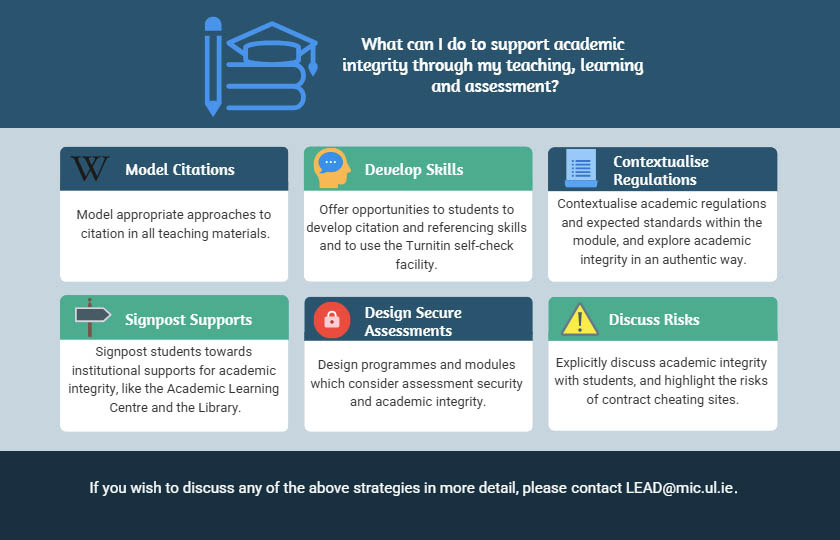
- Model appropriate approaches to citation in all teaching materials. For example, highlight on PowerPoint slides or other teaching materials how you have quoted or paraphrased relevant literature, and remind students of how they should cite reference material in their own work.
- Signpost students towards institutional supports for academic integrity, including the Academic Learning Centre, the Library and this website.
- Contextualise academic regulations and expected standards in the context of the module/programmes and include space within the curriculum to explore academic integrity in an authentic way for students.
- Support students to avail of the Turnitin self-check facility and offer students opportunities to develop their skills in citation and referencing. Note that this facility is limited to members of the MIC community, i.e. those with a staff or student account and access to MIC Moodle. For further guidance, please refer students to the relevant page on the MISU website.
- Apply the MIC Academic Integrity policy and follow the procedure outlined if you encounter a suspected breach of academic integrity.
- Design programmes and modules which consider assessment security and academic integrity (see below and click here to access the TCD guide to strengthening academic integrity through your teaching).
- Explicitly discuss academic integrity with students, and highlight the risks of contract cheating sites who can deliberately target, mislead and even blackmail students (see Rowland et al. (2018) for examples of the insidious behaviour of contract cheating services).
Assessment Design and Academic Integrity
A key approach to promoting academic integrity is through assessment design. Careful assessment design can encourage authentic learning and minimise opportunities for dishonest behaviour. Furthermore, well-structured assessments promote critical thinking, problem-solving and the application of knowledge, rather than rote learning. It can support students to engage with assessment tasks in appropriate and ethical ways.
What does the literature tell us?
A robust body of scholarly literature confirms that assessment design in higher education can significantly influence and support academic integrity (e.g. Bertram Gallant, 2017; Morris, 2016; Sabrina et al., 2022). However, it is important to note that while authentic, personalised and iterative assessment practices can reduce some forms of academic misconduct, no single design feature can ensure integrity, especially given the rising threats to integrity from contract cheating and unethical use of generative AI (e.g. Ellis et al., 2020; Harper et al., 2021; Kofinas et al., 2025; Lehane et al., 2024). Nonetheless, Scott (2017) argues for the importance of creating a strong environment for academic integrity when it comes to assessment design. Scott (2017) asserts:
"We ourselves may be unwittingly creating conditions that facilitate misconduct through the design of our assessments. When we are intentional about incorporating design elements that limit opportunities for misconduct, we promote a stronger academic integrity environment. This in turn facilitates a focus on academic skills development and relationships of trust between students and between instructors and students" (p.264)
Furthermore, Owens and White (2013: 20) point out that "assignments must be designed to ensure that dull, reworded summaries do not obtain strong marks". Therefore, while accepting that there is no panacea when it comes to assessment design, a robust and carefully considered approach to assessment and feedback is an important strategy for supporting academic integrity within an institution.
Authentic Assessment Approaches
As the sections below will highlight, there is no 'silver bullet' when it comes to assessment design, but there are particular approaches and strategies which reduce academic integrity risks:
Assessment Design Strategies to Support Academic Integrity
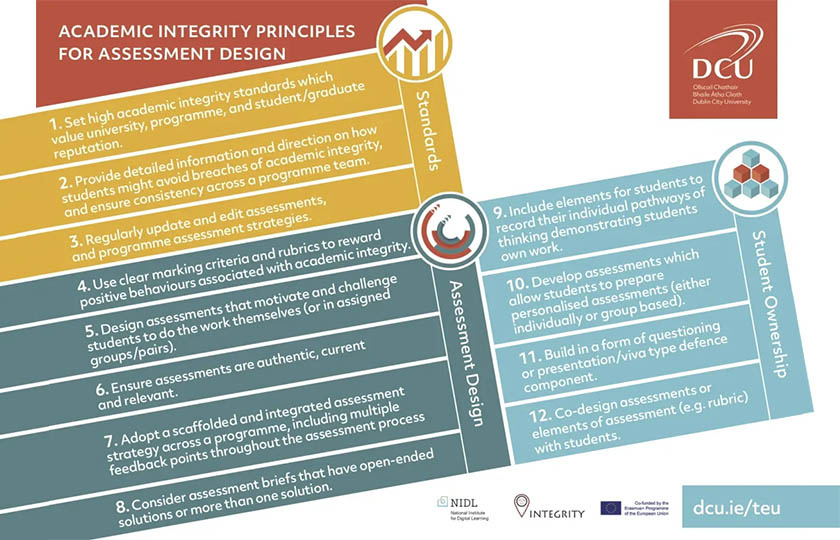
Drawing on Egan (2018), O'Riordan et al. (2021) propose a set of academic integrity principles for assessment design. These principles are organised around three central categories: standards, assessment design and the importance of fostering student ownership of their assessment tasks.
Click below to review each of these categories and consider how these guidelines can support you to design assessment tasks on your modules and programmes:
Set high academic integrity standards which value university, programme and student/graduate reputation. Embed high academic standards into the programme and module, led by University supports and resources. Instill in the programme team, and students, that everyone is both responsible for maintaining high standards, and that they will reap the rewards of being part of a programme with the highest academic integrity.
Provide detailed information and direction on how students might avoid breaches of academic integrity, and ensure consistency across a programme team. Support students to develop their own sense of personal integrity through use of a detailed rubric, examples or exemplars, guidance documents, policy, etc. Use formative feedback to help students develop this form of personal integrity.
Regularly update and edit assessments, and programme assessment strategies. Review and update programme assessment strategy and assessment briefs every year. Repeated use of assessment briefs or tasks encourages students to seek out students from previous years for help (or collusion).
Use clear marking criteria and rubrics to reward positive behaviours associated with academic integrity. Use rubric as class tutorial material. Also, consider designing in a separate reflection component/task with allocated marks in rubric. This can be related to principle twelve i.e. involving students in design of rubric. Click here to access all articles related to rubrics on LEAD's Knowledge Base.
Design assessments that motivate and challenge students to do the work themselves (or in assigned groups/pairs). Include opportunities to allow students to demonstrate their creativity, problem-solving and reflection competencies e.g. project or problem-based assessments.
Ensure assessments are authentic, current and relevant. Consider work- or community- based assessments that are authentic. Another way is to allow students to co-create a bespoke assessment brief to suit their work/life experience.
Adopt a scaffolded and integrated assessment strategy across a programme, including multiple feedback points throughout the assessment process. Inclusion of formative feedback throughout the assessment process supports and scaffolds assessment for learning by offering students opportunities along the way for self, peer or tutor feedback e.g. WIP (Work in Progress).
Consider assessment briefs that have open-ended solutions or more than one solution. When there is no one correct answer, it encourages students to be individual and prevents them from sourcing the solution. This approach combined with formative feedback would be excellent.
Include elements for students to record their individual pathways of thinking, demonstrating students own work. ePortfolios are good examples of requiring students to record their individual pathways of thinking. These can be part of the formative assessment in addition to summative.
Develop assessments which allow students to prepare personalised assessments (either individually or group-based). Personalised assessments require some time to develop a bank of scenarios (case studies or problems) and a system to randomly allocate a different assignment brief to each student (or group). Technology could be leveraged to support this approach.
Build in a form of questioning or presentation/viva type defence component. A summative element of the assessment where students have to ‘defend’ their work is an excellent way of promoting academic integrity because students will be unable to do this component unless they have prepared the assessment themselves.
Co-design assessments or elements of assessment (e.g. rubric) with students. Assessors could have a broad idea of mark allocation and use this as a tutorial class to co-develop the criteria and associated descriptors to co-design the rubric with students.
Assessment Design in the Context of GenAI
Note: Much of the material in this section has been adapted from the 'GenAI for Teaching and Learning: how to do it right' open course, available through opencourses.ie and hosted by the National Forum for the Enhancement of Teaching and Learning in Higher Education (click here to view the open course page). This material has been made available under a CC BY-NC 4.0 licence as open education resources (OER).
As identified in the Generative AI section of the MIC website, the widespread emergence of genAI is changing how we approach teaching and learning in a higher education context. Assessments tend to be a key site of perceived challenge in the context of genAI, with a particular concern relating to how genAI might impact on academic integrity, and more specifically on academic dishonesty.
Within the Higher Education sector, many are asking, how can we maintain a focus on effective assessment without engaging in an unproductive arms race to try to outwit or detect GenAI use? Traditional plagiarism-detection tools are rendered ineffective in this context, as AI becomes more capable of human-like text (see for example, Baron, 2024; Dwivedi et al., 2023). Detection tools which purport to specifically focus on GenAI detection raise some significant implications for privacy, equity, and data security (Dalalah & Dalalah, 2023). There is also a lack of evidence as to whether they are effective, with many institutions citing instances of false positives. Increasingly there has been a recognition that these tools may disproportionally misjudge the work of non-native English writers, resulting in the unfair penalising of non-native speakers with limited linguistic impressions (Liang et al., 2023).
Therefore, we need to refocus on other ways of both ensuring academic integrity and dealing with the challenges posed by GenAI and opening ourselves to the opportunities which it may present. Crawford (2023) writes of the importance of applying a reframed academic integrity lens to artificial intelligence focusing on three principles of authenticity (how assessment will evolve); responsibility (the need for assessment to be responsibly designed with a greater AI independence whilst also upskilling and using these AI technologies as part of students’ educational experience); and accountability (the need for clear communication for and to all in relation to assessment rules and guidance). Reflecting on academic integrity also necessitates reflecting on the ethics of incorporating or not incorporating Gen AI into teaching, learning and assessment.
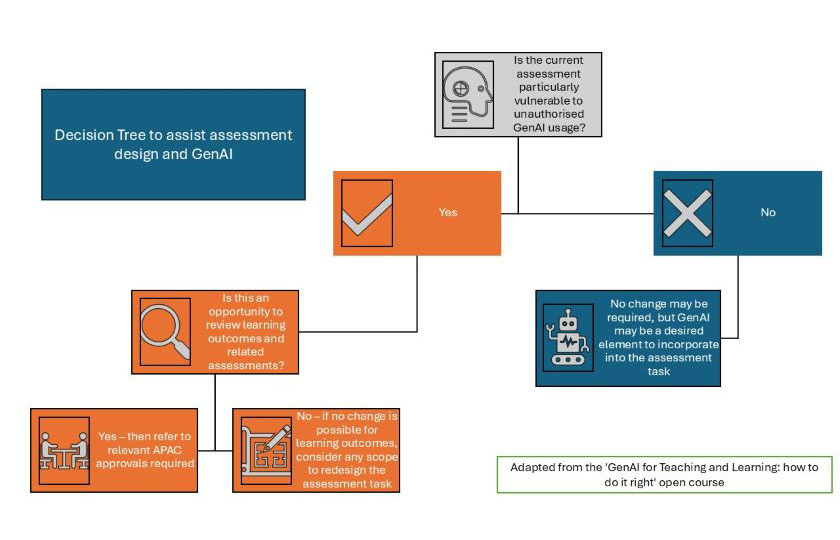
The decision to “design in” or “design out” may depend on several factors but should start with a review of current assessment design, and specifically a review of the alignment of current assessment(s) and learning outcomes. It may also be an opportunity to consider the volume of assessments, and the cohesion across and between assessments in a programme. In reviewing learning outcomes and their associated assessment:
- Consider your module learning outcomes. What do you want your students to achieve with this assessment? What core skills do you intend for them to develop?
- Will the use of GenAI help or hinder students from achieving their learning goals? Consider how exactly students may or may not use GenAI for your assessment in order to meet learning outcomes.
- How vulnerable are these learning outcomes and assessments to GenAI? If the task focuses on knowledge, comprehension, and written accuracy, it will be vulnerable. However, learning outcomes and assessment focused on originality, specific contexts, and critical thinking, may be less vulnerable.
- Is this an opportunity to review learning outcomes and consider the incorporation of higher order skills? If learning outcomes and assessments are already focused on higher order skills, could GenAI be used to further develop these skills?
In reflecting on these key questions, you may now be in a position to decide how to approach your assessment design.
Decision Tree
A decision tree (see diagram below) may be helpful in assisting you to decide whether to design in GenAI or design it out. This is not always a binary decision and there may be degrees to which either approach may be applied. It is also important to note that even if GenAI is designed out of a specific assessment, students may still have used GenAI in their personal study for that assessment. A decision will still need to be made as to the appropriateness of this.
Bloom's Taxonomy
Alternatively, you may find the revisited version of Bloom's Taxonomy (see image below) a useful reflective tool in the consideration of learning outcomes in the context of GenAI. It uses a different way of representation, using the Taxonomy to contrast AI capabilities to human skills. Explore the table below, adapted from Oregon State University.

If, after reflection, you feel that the correct course of action is to design out GenAI, then you may wish to consider some specific approaches to assessment design such as:
- Interactive oral assessments.
- Synoptic/integrated assessment and a focus on programmatic assessment design.
- Staged assessments in which students are required to demonstrate the developmental process of their work e.g. staged submissions of an outline, research notes, drafts, and final version. Feedback may be provided at each stage and the student needs to incorporate/reflect on that feedback at each stage thus creating an iterative process.
- Require students to include materials that are only available in lecture contents, lab work, etc.
- Modify assessments to be more applied to each student’s own local context.
Assessment Design Approaches to Avoid for Summative Assessment
Prof. Phil Dawson (2021) identifies four types of 'common mistakes' which he maintains weakens assessment security, particularly in the context of summative assessment i.e. where the task will contribute towards a students' final grade. By avoiding these mistakes, he argues that assessment security can be enhanced. Click on the accordion below to explore each 'mistake' and the associated rationale, as proposed by Dawson (2021: 132-135).
Reusing the exact same assessment task year on year leads to the risk of students basing their assessment submissions on the work of previously submitted assignments. While text-matching software such as Turnitin should recognise a submitted assignment from a different cohort, this will not be the case if a student has significantly paraphrased an assignment from a previous year.
There is a proliferation of online tools and technologies which can complete online tests on a students' behalf, and there is no way of ensuring that a student has completed a task without support. This strategy should be avoided in the context of summative assessment, but may have significant learning benefits as a formative approach (assessment for learning).
This approach is very vulnerable to collusion, copying or outsourcing through the use of contract cheating services or Generative AI.
Repeating examination questions year-on-year, or offering students the same examination paper but taken at different times, has been shown to compromise assessment security and lead to breaches of academic integrity (McCabe, 2005). Furthermore, there is evidence in the literature that suggests that invigilated exams do not have the level of assessment security that some academic staff expect and in fact a belief in 'the inherent integrity of the exam format has provided a false sense of security' (Harper et al., 2021: 275).
Further Guidance and Resources
- Deakin University, CRADLE suggests… series of research-informed briefings on assessment and feedback
- Maynooth University Assessment and Feedback Resources Hub
- TEQSA Assessment reform in the age of artificial intelligence guidance
- Trinity College Dublin guide to strengthening academic integrity through assessment design
- University College London guide to designing assessments for academic integrity
- University of Toronto 'Smart Strategies' for promoting academic integrity
References
Baron, P. (2024). Are AI detection and plagiarism similarity scores worthwhile in the age of ChatGPT and other Generative AI? Scholarship of Teaching and Learning (SOTL) in the South, 8(2), 151-179.
Bertram Gallant, T. (2017). Academic integrity as a teaching & learning issue: from theory to practice. Theory Into Practice 56: 88-94.
Crawford, R. (2023). Integrity means doing the right thing academically: Let the machines watch on. SEDA Blog. Retrieved 3 December 2025.
Dalalah, D., & Dalalah, O. M. A. (2023). The false positives and false negatives of generative AI detection tools in education and academic research: the case of Chat GPT. The International Journal of Management Education, 21(2), 100822.
Dawson, P. (2021). Defending Assessment Security in a Digital World: preventing e-cheating and supporting academic integrity in higher education. Routledge.
Dwivedi, Y. K., Kshetri, N., Hughes, L., Slade, E. L., Jeyaraj, A., Kar, A. K., Baadullah, A. M., Koohang, A., Raghavan, V., Ahuja, M., Albanna, H., Albashrawi, M. A., Al-Busaidi, A. S., Balakrishnan, J., Barlette, Y., Basu, S., Bose, I., Brooks, L., Buhalis, D.,…Wright, R. (2023). So what if ChatGPT wrote it?" Multidisciplinary perspectives on opportunities, challenges and implications of generative conversational AI for research, practice and policy. International Journal of Information Management, 71, 102642.
Egan, A. (2018). Improving Academic Integrity through Assessment Design. National Institute for Digital Learning (NIDL).
Ellis, C., van Haeringen, K., Harper, R., Bretag, T., Zucker, I., McBride, S., Rozenberg, P., Newton, P., & Saddiqui, S. (2020). Does authentic assessment assure academic integrity? Evidence from contract cheating data. Higher Education Research & Development, 39(3), 454-469.
Harper, R., Bretag, T., & Rundle, K. (2021). Detecting contract cheating: examining the role of assessment type. Higher Education Research & Development, 40(2), 263-278.
Kofinas, A. K., Tsay, C.-H., & Pike, D. (2025). The impact of generative AI on academic integrity of authentic assessments within a higher education context. British Journal of Educational Technology, 00, 1-28.
Lehane, S., Wright, A., & Fenton, P. (2024). Improving academic integrity through authentic assessment design. Irish Educational Studies.
Liang, W., Yuksekgonul, M., Mao, Y., Wu, E., & Zou, J. (2023). GPT detectors are biased against non-native English writers. Patterns, 4(7), 100779.
National Academic Integrity Network (NAIN). (2021). Academic Integrity Guidelines. Dublin: Quality & Qualifications Ireland (QQI).
McCabe, D. L. (2005). Cheating among college and university students: a North American perspective. International Journal for Educational Integrity, 1(1).
Morris, E. J. (2016). 'Academic integrity: a teaching and learning approach'. In T. Bretag (Ed.), Handbook of Academic Integrity (pp. 1037-1053). Springer.
O'Riordan, F., Glynn, M., & Buckley, K. (2021). Academic integrity principles for assessment design. Retrieved 25 June 2025.
Owens, C. and F. A. White (2013). A 5-year systematic strategy to reduce plagiarism among first-year psychology university students. Australian Journal of Psychology 65(1): 14-21.
Rowland, S., Slade, C., Wong, K.-S., & Whiting, B. (2018). 'Just turn to us': the persuasive features of contract cheating websites. Assessment & Evaluation in Higher Education, 43(4), 652-665.
Sabrina F., Azad, S., Sohail, S. and Thakur, S. (2022) 'Ensuring academic integrity in online assessments: a literature review and recommendations', International Journal of Information and Education Technology, 12(1), 60-70.
Scott, S. (2017). From plagiarism-plagued to plagiarism-proof: using anonymized case assignments in intermediate accounting. Accounting Perspectives, 16(4), 247-268.
Sotiriadou, P., Logan, D., Daly, A., & Guest, R. (2020). The role of authentic assessment to preserve academic integrity and promote skill development and employability. Studies in Higher Education, 45(11), 2132-2148.
Except where otherwise noted, content on the LEAD section of this website is licensed under a Creative Commons Attribution 4.0 International licence.
Policy and Guidelines
There is lots of great advice available to staff and students through national and institutional guidelines and policies. To learn more, check out the following resources:
- MIC's Academic Integrity Policy
- The National Academic Integrity Networks' national principles and lexicon of terms
- The National Academic Integrity Network's Academic Integrity Guidelines
- The National Academic Integrity Network's Podcast Series
Please note that the MIC Academic Integrity Policy is currently under review and an updated Policy will be made available in due course.
Except where otherwise noted, content on the LEAD section of this website is licensed under a Creative Commons Attribution 4.0 International licence.
References
Baron, P. (2024). Are AI detection and plagiarism similarity scores worthwhile in the age of ChatGPT and other Generative AI? Scholarship of Teaching and Learning (SOTL) in the South, 8(2), 151-179.
Bertram Gallant, T. (2017). 'Academic integrity as a teaching & learning issue: from theory to practice'. Theory Into Practice 56: 88-94.
Bretag, T. & Mahmud, S. (2016). A conceptual framework for implementing exemplary academic integrity policy in Australian higher education. In Bretag, T. (ed) Handbook of Academic Integrity, Springer, Singapore: 463-480.
Brickhill, M., Andrews, G. & Nieuwoudt, J. (2025). Developing Student Agency Towards Academic Integrity Through an Educative Approach: exploring students’ experiences and perspectives. Journal of Academic Ethics, 23: 951–975.
Crawford, R. (2023). Integrity means doing the right thing academically: Let the machines watch on. SEDA Blog. Retrieved 3 December 2025.
Dalalah, D., & Dalalah, O. M. A. (2023). The false positives and false negatives of generative AI detection tools in education and academic research: the case of Chat GPT. The International Journal of Management Education, 21(2), 100822.
Dawson, P. (2021). Defending Assessment Security in a Digital World: preventing e-cheating and supporting academic integrity in higher education. London: Routledge.
Dwivedi, Y. K., Kshetri, N., Hughes, L., Slade, E. L., Jeyaraj, A., Kar, A. K., Baadullah, A. M., Koohang, A., Raghavan, V., Ahuja, M., Albanna, H., Albashrawi, M. A., Al-Busaidi, A. S., Balakrishnan, J., Barlette, Y., Basu, S., Bose, I., Brooks, L., Buhalis, D.,…Wright, R. (2023). "So what if ChatGPT wrote it?" Multidisciplinary perspectives on opportunities, challenges and implications of generative conversational AI for research, practice and policy. International Journal of information Management, 71, 102642.
Eaton, S.E. (2023). A Comprehensive Academic Integrity (CAI) Framework: An Overview. Calgary, Canada: University of Calgary.
Egan, A. (2018). Improving Academic Integrity through Assessment Design. Dublin: National Institute for Digital Learning (NIDL).
Ellis, C., van Haeringen, K., Harper, R., Bretag, T., Zucker, I., McBride, S., Rozenberg, P., Newton, P., & Saddiqui, S. (2020). Does authentic assessment assure academic integrity? Evidence from contract cheating data. Higher Education Research & Development, 39(3), 454-469.
Harper, R., Bretag, T., & Rundle, K. (2021). Detecting contract cheating: examining the role of assessment type. Higher Education Research & Development, 40(2), 263-278.
Kofinas, A. K., Tsay, C.-H., & Pike, D. (2025). The impact of generative AI on academic integrity of authentic assessments within a higher education context. British Journal of Educational Technology, 00, 1-28.
Lehane, S., Wright, A., & Fenton, P. (2024). Improving academic integrity through authentic assessment design. Irish Educational Studies.
Liang, W., Yuksekgonul, M., Mao, Y., Wu, E., & Zou, J. (2023). GPT detectors are biased against non-native English writers. Patterns, 4(7), 100779.
National Academic Integrity Network (NAIN). (2021). Academic Integrity Guidelines. Dublin: Quality & Qualifications Ireland (QQI).
McCabe, D. L. (2005). Cheating among college and university students: a North American perspective. International Journal for Educational Integrity, 1(1).
Morris, E. J. (2016). 'Academic integrity: a teaching and learning approach'. In T. Bretag (Ed.), Handbook of Academic Integrity (pp. 1037-1053). Springer.
International Centre for Academic Integrity [ICAI] (2021). The Fundamental Values of Academic Integrity. (3rd ed.) Accessed 29 September 2025.
International Centre for Academic Integrity [ICAI] (n.d.) 'Welcome to ICAI!', International Center for Academic Integrity. Accessed 29 September 2025.
O'Riordan, F., Glynn, M., & Buckley, K. (2021). Academic integrity principles for assessment design. Retrieved 25 June 2025.
Owens, C. and F. A. White (2013). A 5-year systematic strategy to reduce plagiarism among first-year psychology university students. Australian Journal of Psychology 65(1): 14-21.
Rowland, S., Slade, C., Wong, K.-S., & Whiting, B. (2018). 'Just turn to us': the persuasive features of contract cheating websites. Assessment & Evaluation in Higher Education, 43(4), 652-665.
Rundle, K., Curtis, G. and Clare, J. (2020). 'Why students choose not to cheat'. In Bretag, T. (ed). A Research Agenda for Academic Integrity'. Cheltenham: Edward Elgar Publishing: 100-111.
Sabrina F., Azad, S., Sohail, S. and Thakur, S. (2022) 'Ensuring academic integrity in online assessments: a literature review and recommendations', International Journal of Information and Education Technology, 12(1), 60-70.
Scott, S. (2017). From plagiarism-plagued to plagiarism-proof: using anonymized case assignments in intermediate accounting. Accounting Perspectives, 16(4), 247-268.
Sotiriadou, P., Logan, D., Daly, A., & Guest, R. (2020). The role of authentic assessment to preserve academic integrity and promote skill development and employability. Studies in Higher Education, 45(11), 2132-2148.
Except where otherwise noted, content on the LEAD section of this website is licensed under a Creative Commons Attribution 4.0 International licence.
- Introduction: Strategies for Integrity
- Institutional Strategies for Environment
- Strategies for Students
- Strategies for Teachers
- Policy and Guidelines
- References