

Bachelor of Science in Climate, Society, Sustainability (MI011)
CAO Points: New Programme
Duration: 4 years full-time
Places Offered:
Location: MIC Limerick
- Programme Overview
- Programme Content
- Entry Requirements
- Ask a Question
Programme Overview
The Bachelor of Science in Climate, Society, Sustainability is a four-year, full-time, honours degree (Level 8). This exciting new programme integrates Geography and a range of other Science and Arts disciplines to study the often-challenging relationship between the environment and humankind. Theoretical learning is supported by practical activities, fieldwork, real-world projects and travel opportunities.

Why study on this programme?
About You
You are curious and empathetic to the world around you, people and the environment. You care about the challenging relationship between climate and humankind. You are committed to a greener, more sustainable future and want to play your part in nudging society in a positive direction. You are a critical thinker, a strong communicator and enjoy both practical and collaborative work; and you are competent with technology, literacy and numeracy.
Why Study the BSc in Climate, Society and Sustainability?
The relationship between climate and society and the need to act sustainably are among the most important challenges facing the world today. It is essential that we embed sustainability into all areas of human endeavour and to achieve this we must trigger a generational shift in our understanding of the environment. This degree offers a deeper, integrated study of the interplay between the physical world and human activity.
The subject is topical, accessible and often fascinating, and is closely connected to real-world issues, including sustainability, technology and geopolitics; wellbeing, inequality and conflict. The approach is innovative, linking core content from Geography with important contributions from other disciplines, for example, climate justice from Philosophy, circular economy from Business, statistics from Maths, and languages from French and German. This approach mirrors the integrated nature of the new leaving certificate subject, Climate Action and Sustainable Development, providing direct onward learning opportunities.
The programme provides a wide range of experiences and skills, both in subject-specific climate/society topics, but also in a variety of transferable skills – literacy, numeracy, communication, teamwork, fieldwork, technologies and media. These skills, combined with growing demand for sustainability expertise across all sectors, prepare graduates for a wide range of career opportunities.
What you will study
Climate, society and sustainability is an interdisciplinary subject that bridges the physical science and arts domains. You will study topics ranging from ecology to ethics and heritage to natural hazards, using a combination of quantitative, scientific analysis and arts-based qualitative approaches. Learning combines lectures, tutorials, case studies (e.g. Waterford’s Climate Action Plan or the 2010 Eyjafjallajökull eruption), and real-world examples (e.g. COVID or Ireland’s housing crisis) to develop critical understanding of contemporary environmental and societal challenges.
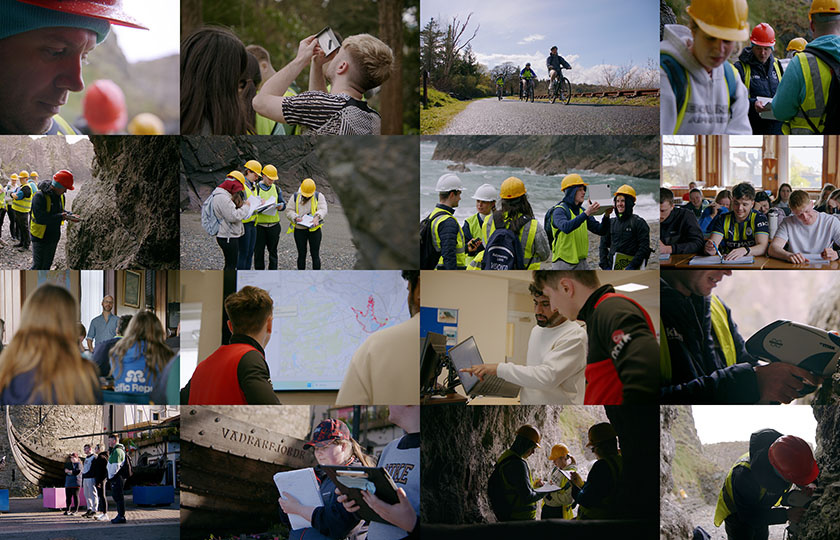
The programme places a strong emphasis on practical learning. Students gain hands-on experience and great opportunities for real-world application. Physical geography activities take place in our dedicated laboratory, including, for instance, analysis of vegetation health, water pollution and greenhouse gas concentration. Geospatial mapping is undertaken using specialist GIS, image processing and computer programming software.
There is a strong emphasis on fieldwork, both as part of subject-based modules and through residential field courses where viable, including international expeditions to locations like Malta or Tenerife. Students are warmly encouraged to broaden their experience through our excellent off-campus programme in Year 3, to undertake a semester- or year-long exchange to one of our partner universities around Europe or further afield. There is also an opportunity for professional placement during the off-campus year, as well as specialist modules that involve working on real-world projects for external organisations.
The degree culminates in an independent research dissertation, where you have the freedom to explore your academic interests in a research project of your choosing. Preparation for this actually starts at the outset of the degree, where you are encouraged simply to observe the world around you, ask questions, be critical. And then in second year, a research methods module coaches you in developing a research proposal, with support from an expert supervisor. By fourth year, students are well equipped to lead their own research and can produce outstanding dissertations; with some dissertations progressing to publication in academic journals.
Career Opportunities
The interplay between climate, society and sustainability is a significant contemporary issue with wide-ranging implications. Expertise on this subject is therefore of direct value in a broad range of employment options and it is expected that this jobs sector will grow in the future. Likely career paths include environmental consultancy, engineering and law; conservation; community development and regeneration; social and climate justice; corporate social responsibility and ethical investment; geospatial analysis; legislation and policy making; diplomatic service; and research. The programme will also provide excellent initial training towards careers such as teaching and planning, though postgraduate study and/or professional accreditation may also be required. Potential employers include civil service and government agencies; NGOs; environmental and geospatial organisations; private sector; academia; and education.
Undergraduate Entrance Scholarships
Each year, Mary Immaculate College awards up to 50 Undergraduate Entrance Scholarships across all undergraduate programmes valued at €2,000 each, on the basis of results obtained in the Irish Leaving Certificate Examination.
Further information about Undergraduate Entrance Scholarships available here.
Contact
Programme Coordinator and Head of Geography Department
Prof. Paul Aplin
Tel: 061 204210
Email: Paul.Aplin@mic.ul.ie
- Programme Overview
- Programme Content
- Entry Requirements
- Ask a Question

