Close icon
Close icon

Postgraduate Diploma / M Ed / Structured PhD in Literacy Education

**Save the Date 6 & 7 November 2026 - LAI (Literacy Association Ireland) Conference at MIC, Limerick.

Available: Part-time

NFQ Level: M Ed 9/PhD 10*

Duration: 1 yr / 2 yrs /4+yrs

Location: Blended

Programme Duration Details:

Postgraduate Diploma 1 yr / M Ed 2 yrs/ Structured PhD in Literacy Education 4+ yrs

Assessment:

Assignments predominantly

  • Programme Overview
  • Programme Content
  • Entry Requirements
  • How to Apply
  • Ask a Question

Programme Overview

You may be embarking on a new teaching post, or you may be an established professional looking to upskill in a changing environment. Whatever your ambitions, this course will inspire and enable you to discover your own literacy voice and make the most of it in the next stage of your career journey.
You will graduate as a respected and versatile Literacy Leader, steeped in practical and professional knowledge. You might, like graduates before you, translate that experience into a career at third level in the field of Literacy Education; teacher advisory posts; inspectorate roles; principal positions (teaching and admin); senior leadership (AP1 and AP2 posts) and, in some cases, permanent teaching posts following a period of uncertainty.

Key Features

The Postgraduate Diploma / M Ed / Structured PhD in Literacy Education fosters the development of research, critical thinking and communication skills within the context of the evolving nature of literacy in the twenty first century.

It is of particular interest to classroom teachers, aspiring literacy leaders, school principals, policy makers and those engaged in the provision of continued professional development in the area of Literacy Education.

Back in 2018, MIC pioneered a Masters/Doctoral level programme in Literacy Education which is now highly regarded nationally as an established leader in the field.

The Postgraduate Diploma / M Ed / Structured PhD in Literacy Education programme is designed for people with a committed interest in literacy education and an ambitious approach to their career trajectory.
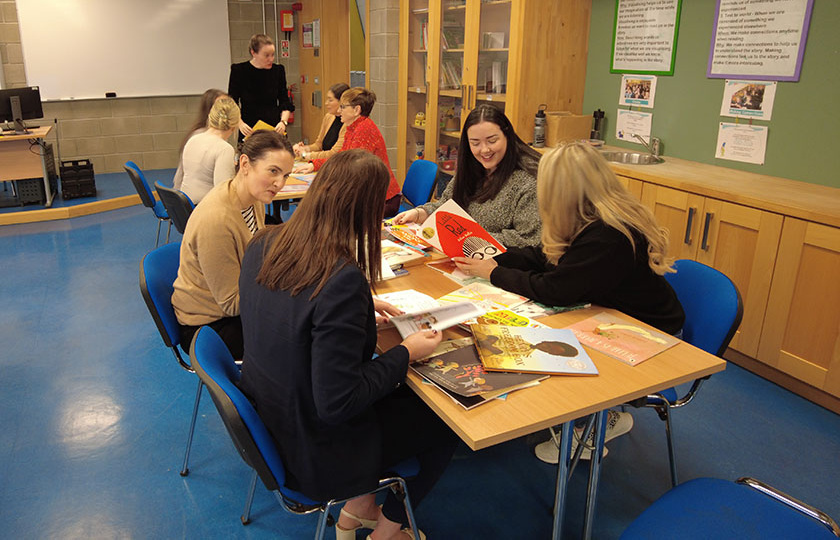
Students sitting at a table in a classroom.
M Ed in Literacy Education – Aimed at people with a committed interest in literacy education.

Hear From Current Students

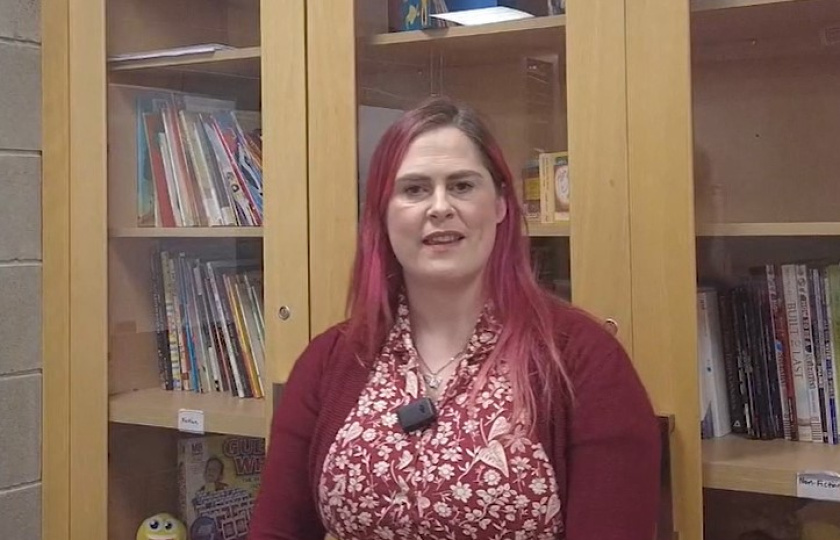
Lady in classroom
WATCH: M Ed in Literacy Education Student Testimonials

What Our Students Say

The M Ed in Literacy Education was the best personal and professional investment I have made! It was worth every penny, every late night study session, every early Saturday morning, every long reading, every tear and every bit of energy I had left over after work. It takes grit and sacrifice but it is incredibly worthwhile because the course coordinator, Josie Brady, makes it so! - Read more
Joelle Fitzgibbon - MEd in Literacy Education

My return to MIC marked my 20th anniversary since my B Ed and I was so nervous. I had been busy with life, both in and out of the classroom since graduation, but felt that it was the right time to extend my learning. I was apprehensive starting out as it had been so long since I had even looked at things like academic writing and research, but it was clear from my first interaction with Josie that this course was a highly supportive one. - Read more
Teresa Coughlan - MEd in Literacy Education

Read more about what our graduates have to say about the MEd in Literacy Education programme.

All Student Testimonials

I have always had a keen interest in the area of literacy and my work in school in recent years has been to support those pupils who are experiencing significant literacy difficulties. I wanted to extend my knowledge in order to better support these pupils. The MEd in Literacy Education was the ideal choice for me as it offered a comprehensive programme delivered in a blended approach, perfect for juggling work, a busy family life and study. - Read more
Evelyn Quin - M Ed in Literacy Education

I would recommend the M Ed in Literacy Education to anybody interested in upskilling their classroom literacy instruction, and those with intentions of being involved in literacy leadership or academic research going forward. - Read more
Eoghan O’Connor - M Ed in Literacy Education

The course has given me great confidence in the area of Literacy and I am now seen as a Literacy leader within my school. Teachers come to me for advice with teaching Literacy and I have also demonstrated and modelled best strategies in Literacy to many of my colleagues. - Read more
Aideen O'Connor - M Ed in Literacy Education
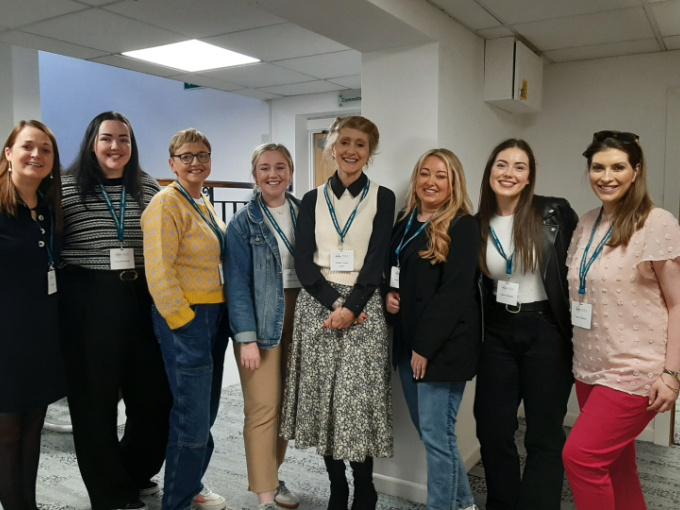
M Ed Literacy students with Prof. Teresa Cremin.

From the outset, my lecturer allayed my fears over my writing skills. It had been quite a while since my last course, so I felt a little out of touch and that maybe I would be too far behind everyone else. I am paraphrasing her now, but she more or less said, “I can hear your voice in your writing. I have students who have all the writing skills, but I can’t hear their voice". This gave me great encouragement to continue to develop ‘my voice’ and also upskill in the techniques of academic writing. - Read more
Edmond Scannell - M Ed in Literacy Education

Going forward, I plan to continue to develop my practice as a teacher, research areas I wish to know more about and to engage with new research and methods of teaching. I did this course because I wanted to become a better teacher and I feel I am far more knowledgeable and confident as a teacher having completed it. If you have an interest in literacy education and developing your practice, this is certainly the course for you! - Read more
Sarah O'Callaghan

This course provides you with the opportunity to meet like-minded people who also share an interest in Literacy Education. Continuous support is given to students by knowledgeable lecturers. I have been inspired and motivated through lectures, workshops and guest speakers in specialist areas. I have particularly enjoyed engaging in the area of Children’s Literature, which became a key component of my research during this course. I would highly recommend this programme to anyone who is interested in postgraduate education. - Read more
Sarah Quirke - MEd in Literacy Education

I am passionate about the area of Teaching English as an additional language and there seemed to be good scope to explore this in greater details. The course was filled with practical advice and suggestions to apply in the classroom. I really enjoyed getting lectures from Speech and Language therapists and specialists in all areas of literacy, as I found that there was so much opportunity to ask questions that I had around teaching language in general.
Ross O' Connor - M Ed in Literacy Education

Contact

Dr Josephine Brady, Programme Coordinator

E: Josephine.Brady@mic.ul.ie

Please feel free to email me with any queries or comments and I will do my best to help you.

NFQ Levels

*Postgraduate Certificates are Level 9 Minor Awards, Postgraduate Diplomas and Masters are Level 9 Major Awards and PhDs are Level 10 Major Awards on the National Framework of Qualifications (NFQ), awarded by the University of Limerick.

Programme Content

Postgraduate Diploma / M Ed in Literacy Education

The programme is specifically designed to support the busy lives of  in-service teachers and other educational practitioners.

There are four taught modules in the Autumn semester and four taught modules in the Spring.

The commitment is one Saturday per month (four Saturdays each term) in-person at MIC, Limerick and on-line sessions or tutorials primarily in the third and fourth week, leading up to the monthly Saturday in-person day.

Credits (Taught and Research) split over two years*

Please note: At the end of Semester 2 of Year 1, you may, if you choose, qualify for a Postgraduate Diploma in Literacy Education qualification, provided you fulfil the University requirements for such an award.

Semester 1 (Year 1)
Foundations of Literacy Acquisition and Development
Diversity in Literacy Acquisition and Development
Advanced Research Methods 1: Principles and Practices of Research in Education
Critical Approaches to Children’s Literature
Semester 2 (Year 1)
Inclusive Literacy Pedagogy
Promoting Effective Literacy Leadership in Educational Settings
Advanced Research Methods 2: Critical and Interpretive Research in Educational Settings
Writing a Research Proposal
Semester 3 (Year 2)
Dissertation 1 (M-Grade)
Semester 4 (Year 2)
Dissertation 2 (M-Grade)

Structured PhD

Students may, in discussion with the course team, decide at the end of Semester 2 of Year 1 to continue onto the PhD stage of the programme.

Prospective doctoral candidate will develop a research proposal and submit it for approval at department and faculty level in terms of academic merit and suitability of topic. Only students whose proposals have been approved at PRSC are eligible to continue onto the doctoral component of the programme.

Academic progress during stage two of the Structured PhD in Literacy Education will continue to be monitored by the Doctoral Studies Progression Panels, in accordance with general academic regulations. The panels will include a principal supervisor, plus any additional supervisor(s) and at least one other member, who will act as the student’s independent panel member advisor. 

360 Credits (Taught and Research) split over four years

Semester 1 (Year 1)
Foundations of Literacy Acquisition and Development
Diversity in Literacy Acquisition and Development
Advanced Research Methods 1: Principles and Practices of Research in Education
Critical Approaches to Children’s Literature
Semester 2 (Year 1)
Inclusive Literacy Pedagogy 1
Promoting Effective Literacy Leadership in Educational Settings
Advanced Research Methods 2: Critical and Interpretive Research in Educational Settings
Spring Masterclasses
Summer (Year 1)
Individual doctoral thesis work under supervision of designated supervisor and Doctoral Studies Panel
International Research Methods Summer School (IRMSS) subject to availability
Semester 3 (Year 2)
Individual doctoral thesis work under supervision of designated supervisor and Doctoral Studies Panel
Advanced Research Methods 3: Collecting and Analysing Cross Sectional and Statistical Data in Educational Settings
Graduate Studies Generic Skills
Semester 4 (Year 2)
Individual doctoral thesis work under supervision of designated supervisor and Doctoral Studies Panel
Descriptive and Inferential Statistics in Educational Research
Graduate Studies Generic Skills
Summer (Year 2)
Individual doctoral thesis work under supervision of designated supervisor and Doctoral Studies Panel
Semester 5 & 6 (Year 3)
Individual doctoral thesis work under supervision of designated supervisor and Doctoral Studies Panel
Summer (Year 3)
Individual doctoral thesis work under supervision of designated supervisor and Doctoral Studies Panel
Semester 7 & 8 (Year 3)
Individual doctoral thesis work under supervision of designated supervisor and Doctoral Studies Panel
Summer (Year 4)
Individual doctoral thesis work under supervision of designated supervisor and Doctoral Studies Panel

Entry Requirements

The minimum entry requirements for this programme are as follows:

Applicants should normally be the holders of a first class honours primary degree or upper second class honours (2.1) primary degree (Level 8, NFQ) in a relevant or cognate discipline that incorporates a substantial education or social science component.

Or

A Master's degree or equivalent qualification (Level 9, NFQ), at a minimum 2.2 honours level, in Literacy Education, that has been obtained from a university or other institution recognised by the University of Limerick and in accordance with the University of Limerick Policy on the Recognition of Prior Learning.

Applicants for whom English is not a first language must provide evidence of their proficiency level in English in the form of an IELTS (International English Language Testing System) composite score of 6.5 – 7.0 with no less than 6.0 in any one component, or IELTS equivalent accepted by UL. Such applicants will be required to undergo an interview through English.

And

  • Submission of a research proposal (PhD applicants only - please contact the programme coordinator in the first instance) .

For English language requirements, click here.

How to Apply

Postgraduate Diploma/ M Ed / Structured PhD in Literacy Education

The Postgraduate Diploma / M Ed / Structured PhD in Literacy Education is now open for applications however please note: places on the programme will be strictly allocated in accordance with the date order of qualifying applications received.

To apply, please complete all the steps below:

  1. Download and complete the application form here (application fee Payment Ref Number required).
  2. Please pay the non-refundable €50 application fee here using Stripe, and return the completed application along with the supporting documents below by email only to josephine.brady@mic.ul.ie  and  TaughtProgrammes@mic.ul.ie.

What to include with your Application

You will be required to send:

  1. University transcripts and certificates (including MIC and UL transcripts is applicable).
  2. If English is not your first language/language of qualification, you will require:
  • English translation of transcript/qualification
  • Your English Language Competency Certificate (Academic IELTS or equivalent)

Closing date for applications is 4pm, Friday 14 August 2026

Please note, four places left for September 2026

Please Note: This programme is not open to applications from non-EU countries. Application fees are non-refundable due to applicant ineligibility. See International programme listing here.


Structured PhD in Literacy Education

The Structured PhD in Literacy Education programme is dependent upon staffing capacity for doctoral supervision. 


For fees click here.

Contact
Programme Coordinator
Dr Josephine Brady
+353 85 8702647

Ask a Question

  • Programme Overview
  • Programme Content
  • Entry Requirements
  • How to Apply
  • Ask a Question