

Irish and International Scholars Explore New Frontiers in Life-writing at Online Conference
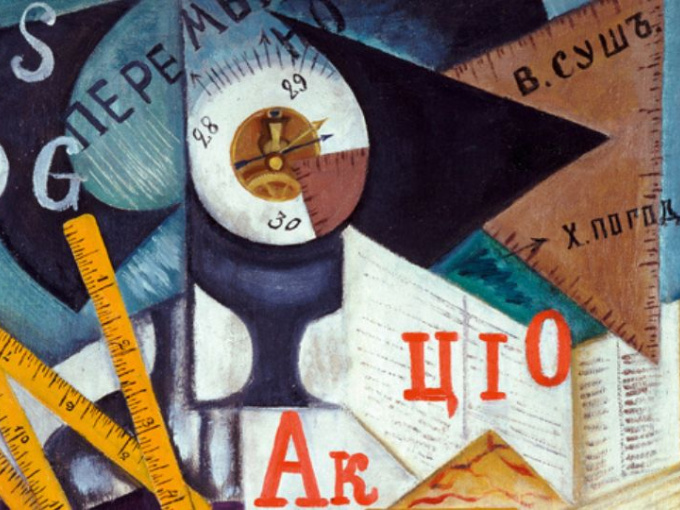 Olga Rozanova "Writing Desk" (1916)
 While most of the European continent was gripped by a stifling heatwave, Irish and international scholars were connecting for the online conference “The Road Less Travelled? Irish-European Lives and Multi-Modal Approaches to Life-Writing” (MIC/FSU Jena, 25-26 June)
The conference - organised by Dr Sabine Egger, Associate Professor in German Studies at Mary Immaculate College (MIC) and Apl Professor Fergal Lenehan, Friedrich Schiller-University of Jena - marked another step in the DAAD-funded project “Elizabeth Shaw’s Irish Berlin” (2025-2026), with research into intercultural autobiography as one of its core aims.
Inspired directly by Elizabeth Shaw’s paradigm-shattering memoir How I Came to Berlin - published in English for the first time as part of the project in 2025 - the conference examined how contemporary Irish life-writing increasingly transcends traditional genres such as memoir and autobiography. Instead, it embraces multimodal and multi-genre forms, while interrogating the narrow definitions of ‘Irishness’ and identity within a transnational European framework. While this certainly applies to the greater number of the examples discussed during the two-day event, there was also wider and continuing engagement with literary memoir and autobiography more generally.
The conference commenced with a keynote address by Liam Harte (University of Manchester) reflecting on the “autobiografiction” of John Banville and raising many questions regarding the fluid lines between fiction and autobiography. This paper was followed by Eamon Maher (TU Dublin) and Lukas Ernst (TCD) who pondered similar questions relating to the work of Jean Sulivan and John McGahern as well as the plays of Dermot Bolger. Lukas Ernst discussed how the theatre can stage an embodied self while the staging also points to its fictional, rather than ‘authentic’ character. From here the conference took a creative turn with Eda Sagarra (TCD), Adeline Henry (Ulster University) and Rachel Fehily (UCD) engaging with their own authorship of memoir and autobiographical fiction in a session called “Life-Writing Between Scholarship and Practice”. Following this Mary M. Burke (University of Connecticut) and Patricia Kennedy (UCC) presented papers on Irish traveller autobiography since the 1970s and the palimpsest layers of travelling womanhood in life-writing. The second keynote address was then commenced by Marie Schröer (University of Potsdam), who gave an overview of contemporary scholarship on autobiographical comics – a relatively new and growing field.
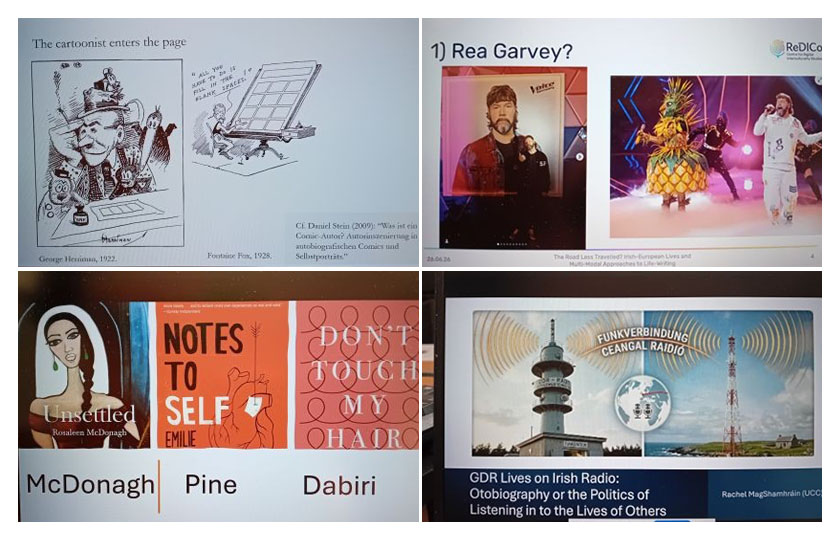 A selection of screenshots from the many presentations, as part of the online conference.
Top left - Marie Schröer (keynote), "Border Crossings: Autofictional Life Writing in Comics", Bottom left - Mary M. Burke, "Irish Traveller Life Writing, 1972-2009", Top right - Fergal Lenehan, "Portrait of the Irish-German Music/TV Star as a Young Man: Rea Garvey", Bottom right - Rachel MagShamhrȧin, Breandán Ó hEihir's Radio Documentary "East Germany Today" (1985)
An artist roundtable discussion concluded the evening, with Hugo Hamilton, author of The Speckled People (2003), a bestselling memoir that redefined Irish autobiography with its “progressive polyethnic vision” (Harte 2018), and Evgeny Shtorn, an LGBTQ+ activist and author of the forthcoming Refugee Chronicles (Skein, 2026), discussing the nature of their work. Their exchange opened fascinating insights into creative processes, the play with and transgression of genre and medial boundaries, forms of authenticity and activism, and the future of life-writing in a world marked by ubiquitous digitality.
The multi-modal nature of life-writing was reflected on further in the first Friday session, where Rachel MagShamhráin (UCC) presented on Breandán Ó hEihir’s radio documentary East Germany Today (1985), raising questions on production and auditory perception, Fergal Lenehan (FSU Jena) gave a paper examining the memoir and linked YouTube documentaries of Irish-German rock and television star Rea Garvey, while Claire O’Reilly (UCC) shed light on the methodology of life-writing, (digitally-conducted) biographical interviews and virtual exchange in third-level education. The conference concluded with a discussion of Limerick author Kate O’Brien’s exile writing by Maggie O’Neill (University of Galway) and a paper on Irish-Greek literary-autobiographical links by Vasiliki Tatouli (MIC). Following concluding remarks by the conference organisers, the participants turned off their computers and looked to cool down as temperatures soared even further.
The online format, it was agreed, allowed for a sustainable and inclusive coming-together of researchers and participants from across Ireland, Europe, the UK and the United States.
Sincere thanks to all presenters and participants for thought-provoking papers and exchanges, to colleagues for chairing such engaging discussions, despite the temperatures (Eoin Flannery, Gisela Holfter, Deirdre Flynn, Kathryn Laing and Caoilfhionn Ní Bheacháin) and to the MIC’s Faculty of Arts Office, Strategic Communications and Marketing Office, Research & Graduate School Office, Dr Ailbhe McDaid, DAAD Language Assistant Charlotte Lehmpfuhl and Project Research Assistant Dr Hanna Rompf for their support.
The organisers also wish to thank the DAAD for funding the event.
Further information, conference programme and abstracts can be found here.

